


Zero In The Gate
Publisher: The Crime Club
Format: Hardback
ISBN: none
Zero in the Gate (1960) by Stewart Farrar. The Crime Club. No ISBN. Condition: Very Good. Ex-library copy with original library ticket showing four borrows in 1963.
There was a glorious age when crime novels did not merely promise murder—they practically invited you onto the film set, handed you a notebook and suggested you keep your eyes open because absolutely everybody looked suspicious.
Zero in the Gate is very much one of those books.
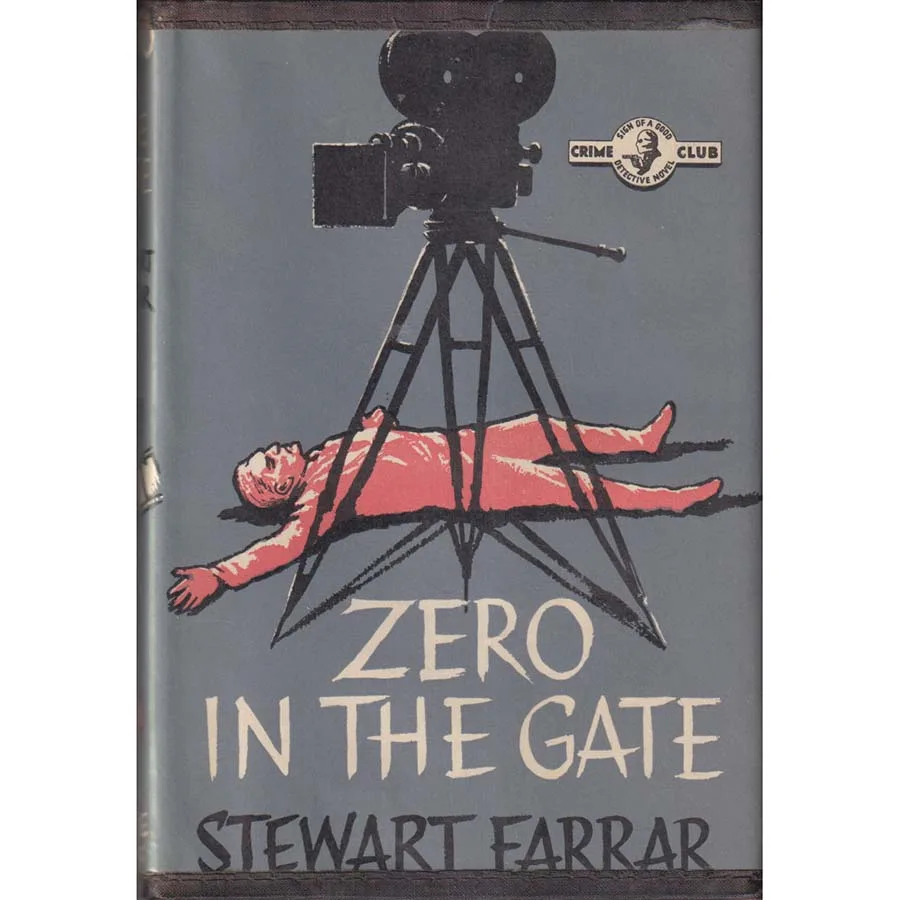
Published in 1960 by the legendary Crime Club, Stewart Farrar’s novel immediately serves notice that this is not going to be a quiet afternoon in the countryside. The wonderfully dramatic dust jacket, featuring a motion-picture camera looming over a conveniently deceased individual, practically shouts, "Somebody knows something... and someone else very much wishes they didn’t."
Subtle? Not remotely.
Effective? Absolutely.
Stewart Farrar was one of those wonderfully versatile writers whose career wandered through journalism, fiction, television, and later, rather unexpectedly, books on witchcraft. That makes him the sort of author whose bibliography resembles a particularly adventurous sat-nav route. Yet here he is firmly in detective territory, where secrets, motives and carefully concealed truths remain far more dangerous than they first appear.
The setting is delightfully redolent of its era. The late 1950s and early 1960s positively adored stories involving film studios, television productions and the curious mixture of glamour and exhaustion that surrounded Britain’s entertainment industry. Behind the cameras and polished smiles lurked jealousy, ambition, professional rivalries and, naturally, murder. Because if detective fiction has taught us anything, it is that no workplace is complete until someone turns up dead.
One of the pleasures of vintage crime fiction is watching investigators solve cases using nothing more sophisticated than observation, deduction and the occasional telephone. No DNA databases. No mobile phone records. No CCTV footage from seven different angles. Just patient detective work, inconvenient witnesses and the uncomfortable realisation that human beings have always been perfectly capable of lying without technological assistance.
The Crime Club editions themselves have acquired a devoted following over the years, and with good reason. They represent a period when British detective fiction was flourishing, producing shelves of ingenious mysteries wrapped in wonderfully evocative dust jackets. Half the pleasure lies in admiring the artwork before you’ve even reached Chapter One.
This copy also comes with an extra layer of charm.
It is an ex-library book, complete with its original library ticket tucked into the back, recording just four borrows in 1963. One cannot help wondering about those four readers. Did they all guess the culprit? Did one stay up until two in the morning to finish it? Did another absent-mindedly return it a day late and incur the sort of library fine that felt like financial ruin when you were fourteen? The ticket quietly records their existence without revealing their stories—a tiny piece of social history preserved between the covers.
Happily, despite its institutional past, the book remains in very good condition. It has survived its years on library shelves remarkably well, retaining both its handsome Crime Club dust jacket and the quiet dignity of a well-made hardback that has spent more time being respected than abused.
From Crappy Old Books—because ex-library books have always struck us as rather noble creatures. They weren’t bought to decorate shelves or impress visitors. They were bought to be read by ordinary people, borrowed on wet Tuesdays, slipped into satchels, returned with satisfaction and then quietly sent back out to do it all again. This one only clocked up four recorded outings in 1963 before settling into retirement. Sixty-odd years later, it’s ready to investigate one more mystery: namely, whether you can solve the case before the detective does. If not, at least you’ll have enjoyed one of the finest dust jackets in the business while trying.
Keep browsing: See more Crime books Other books by Stewart Farrar
